
- 3 Views
- 5 Min Read
- (0) Comment
Combining Shoebill and Subset at Mabamba. Most visitors plan their Mabamba trip around one thing: the shoebill. But the wetland has a second attraction that’s easy to miss if you’re only thinking about morning birding — the sunset over Lake Victoria’s shoreline, with the papyrus swamp turning gold and silhouettes of fishing boats drifting past. Combining the two into a single late-afternoon outing gives you a completely different experience from the classic early-morning canoe ride, and for many travelers, it’s the more memorable one. Here’s how to plan a shoebill-and-sunset trip to Mabamba Wetland and what to expect from timing to conditions.
Why Consider an Afternoon Trip at All
Almost every guide will tell you mornings are best for shoebill sightings, and that’s true — the birds are most active feeding between roughly 6:00 and 9:00 a.m. But shoebills don’t disappear for the rest of the day. They continue hunting and resting through the afternoon, particularly in the cooler hours after 4:00 p.m. when activity picks up again before sunset. This makes late afternoon a legitimate second window for a sighting, not just a consolation option, and it comes with a bonus the morning trip doesn’t offer: dramatic light for photography and a genuinely beautiful end to the day on the water.
The Best Time to Start a Sunset Combination Tour
To combine both experiences well, timing your departure matters more than usual. A good rule of thumb is to arrive at Mabamba landing site by around 4:00–4:30 p.m., leaving enough daylight for an unhurried canoe search before the light starts to fade. Sunset over Lake Victoria typically falls between 6:45 and 7:00 p.m. depending on the season, so a departure in this window gives you roughly two to two and a half hours on the water — enough time to search calmly for the shoebill and still be positioned in open water as the sky turns color. Our Mabamba Shoebill Watching tours can be scheduled for this afternoon slot on request, rather than the standard early-morning departure.
What the Experience Actually Looks Like
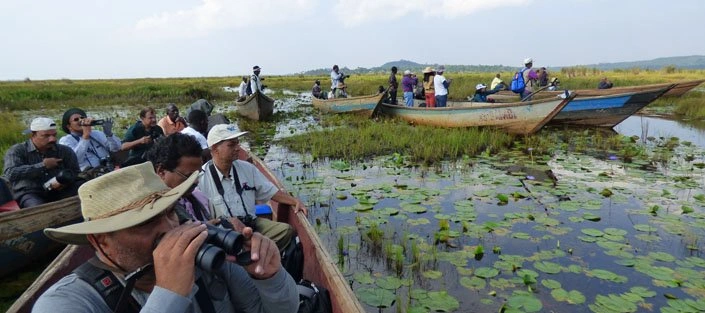
The rhythm of an afternoon trip is noticeably different from a morning one. Instead of racing against rising heat and boat traffic, the pace is slower and quieter almost by default, since fewer canoes are out on the water later in the day. A typical outline looks like this:
- Arrival and canoe departure (4:00–4:30 p.m.): Meet your guide at the landing site and set off into the papyrus channels while the light is still bright and even.
- Shoebill search (4:30–6:00 p.m.): Move slowly through known feeding and resting spots, with your guide reading recent activity to decide where to head first.
- Transition to open water (6:00–6:30 p.m.): As light starts to soften, guides often steer toward more open stretches of the wetland or the lake edge, both for better sunset visibility and because birds sometimes reposition here in the evening.
- Sunset (6:45–7:00 p.m.): With the canoe settled in open water, this is the payoff moment — papyrus silhouettes, fishing boats returning for the evening, and a sky that shifts from gold to deep orange over Lake Victoria.
Because the light changes so quickly in the final thirty minutes, guides generally recommend having your camera ready well before the sun actually touches the horizon.
Photography Tips for the Combination Trip
An afternoon and sunset trip rewards a bit of extra preparation if photography is a priority:
- Use a fast shutter speed for the shoebill. Even though it moves slowly, low evening light can blur handheld shots, so bumping ISO slightly helps keep the bird sharp.
- Switch to silhouette framing near sunset. Papyrus stems, distant canoes, and birds in flight all read beautifully as dark shapes against an orange sky.
- Bring a lens cloth. Humidity near the water increases as temperatures drop in the evening, and lenses fog more easily than they do in the drier morning air.
- Don’t over-rely on zoom for the sunset shots. Wider shots that include the canoe, water, and horizon often capture the mood of the moment better than a tightly cropped sky.
Who This Trip Suits Best
A shoebill-and-sunset combination works particularly well for a few kinds of travelers: photographers who want the best light rather than the best birding odds, couples looking for a more romantic or relaxed outing than an early alarm allows, and repeat visitors who’ve already seen the shoebill on a previous morning trip and want a different experience of the same wetland. It’s less ideal for serious birders whose primary goal is maximizing the odds of a shoebill sighting, since morning remains statistically the stronger window for that specific goal.
Combining This with a Wider Uganda Itinerary
An afternoon Mabamba trip fits naturally at either end of a longer stay. Travelers flying out of Entebbe in the evening sometimes use it as a final activity before heading to the airport, since the wetland sits conveniently along that route. Others use it to bookend a longer safari, pairing it with itineraries like our 3-Day Gorilla Trekking Safari or a stop in Queen Elizabeth National Park, using Mabamba as a scenic, low-key close to the trip rather than a full birding-focused day. If you’re assembling a broader route across Uganda’s parks and want the transfers and timing handled for you, the planning team at Pick and Transfer Safaris can help sequence a multi-day itinerary so a sunset evening at Mabamba lines up naturally with the rest of your travel.
What to Bring
- A light jacket or wrap. Evenings on the water cool down faster than you’d expect, especially once the sun is down.
- Insect repellent. Mosquito activity picks up around dusk near the wetland.
- A headlamp or phone flashlight. Useful for the short walk back to the vehicle after dark.
- Binoculars. Even in fading light, they help pick out distant birds before the canoe gets closer.
Seeing a shoebill is the reason most people come to Mabamba, but staying for the sunset turns the same trip into something quieter and more visually rewarding. If your schedule allows it, an afternoon departure timed to end with golden light over Lake Victoria offers a version of Mabamba that most visitors never see. To check availability for an afternoon or sunset-timed departure, browse our full list of Mabamba shoebill trips or contact our team directly to arrange the timing that works best for you.